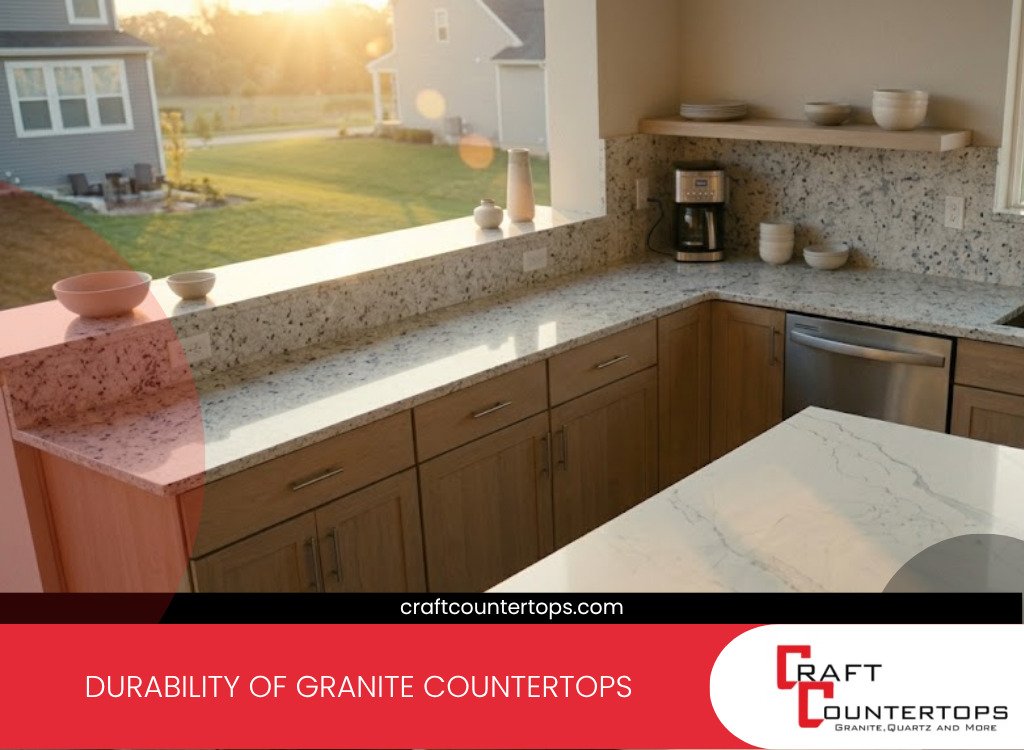
Durability of Granite Countertops: What 30 Years in the Kitchen Looks Like
Granite has been one of the most popular countertop materials in American kitchens for decades. That is not a coincidence.
Homeowners who installed granite in the 1990s are still cooking on the same countertops today. Not because they had no choice — but because properly maintained granite genuinely lasts.
But “durable” means different things to different people. Some homeowners want to know if granite scratches. Others want to know about heat. Others worry about staining after spending thousands of dollars on a new kitchen.
This guide answers all of it — directly and honestly.
How Durable Is Granite, Really?
Granite is one of the hardest natural materials used in residential construction. It ranks between 6 and 7 on the Mohs hardness scale — the same scale used to measure mineral hardness. For context, a steel knife blade ranks around 5.5. Glass ranks around 5.5 too.
That means granite is harder than most things that come into contact with it in a kitchen. Everyday utensils, cookware, and cleaning tools will not scratch granite under normal use.
The durability of granite countertops also comes from its density. Granite is a igneous rock formed when molten magma cools slowly deep underground. That slow cooling process creates an interlocking crystal structure that makes the stone exceptionally strong and resistant to cracking under normal household stress.
That said, no countertop material is indestructible. Understanding exactly what granite handles well — and where its limits are — helps you make the right decision and take care of your investment properly.
Scratch Resistance
Granite is highly scratch resistant. Everyday kitchen use — cutting, scraping, sliding pans across the surface — will not leave visible marks on a properly finished granite countertop.
The main scratch risk comes from other stone or hard mineral materials. Dragging a ceramic pot or another piece of granite across the surface could theoretically leave a mark. In real kitchen use, this is not a practical concern for most homeowners.
One common question: can you cut directly on granite? Technically yes — granite will not be damaged. But your knives will be. The hardness that makes granite scratch resistant also dulls knife edges quickly. Always use a cutting board.
Heat Resistance
The durability of granite countertops under heat is one of its strongest selling points. Granite formed under temperatures far beyond anything a home kitchen produces. A hot pan, a baking sheet from the oven, or a slow cooker will not crack, discolor, or damage granite.
This is a meaningful practical advantage over quartz, which contains polymer resin that can be damaged by direct sustained heat. With granite, the risk of heat damage in normal cooking situations is essentially zero.
That said, using trivets is still a good habit. Not because granite needs the protection — but because sudden extreme temperature changes (thermal shock) can theoretically stress any stone. In everyday cooking, that scenario is unlikely. But protecting a significant investment costs nothing.
See the full heat resistant countertops comparison for a side-by-side look at how granite compares to quartz, quartzite, and marble under heat.
Stain Resistance
This is where granite requires honest conversation. Granite is porous — it has tiny microscopic pores throughout the stone that can absorb liquids if left unsealed.
Wine, oil, coffee, and dark liquids can seep into unsealed granite and leave permanent stains. This is the #1 fear homeowners express when considering granite — and it is legitimate. But it is also entirely preventable.
A properly sealed granite countertop resists everyday stains very well. Liquids bead up on the surface rather than soaking in. As long as spills are wiped up in a reasonable time — within minutes, not hours — sealed granite handles them without issue.
The maintenance commitment is periodic resealing — typically every one to three years depending on use and granite color. See the complete granite sealing guide for the full schedule and the simple water bead test that tells you when resealing is needed.
Craft Countertops seals every new granite installation as part of the process. You start with full protection from day one.
Chip and Crack Resistance
Granite is hard but not flexible. Under enough force — a heavy object dropped directly onto an edge, for example — granite can chip, particularly at corners and edges.
In practice, chipping from normal kitchen use is uncommon. The most vulnerable spots are thin edge profiles and areas near sink cutouts where the stone is thinner. Choosing a slightly thicker edge profile reduces this risk.
Full cracking of a granite countertop under normal household use is very rare. Granite can crack if it is improperly supported during installation or if a structural shift affects the countertop from below — but these are installation and structural issues, not material failures.
Choosing a fabricator with proper installation experience matters here. Correct templating, support bridging, and seam placement all affect long-term performance.
How Long Do Granite Countertops Last?
Properly installed and maintained granite countertops last the lifetime of the home. There is no meaningful expiration point for granite — it does not wear out, fade, or degrade over time the way softer or engineered materials can.
Many granite countertops installed in the 1980s and 1990s are still in service today looking essentially the same as when they were installed. The stone itself does not age in any negative way. The only thing that changes is the sealant, which needs refreshing periodically.
According to the Natural Stone Institute, natural stone countertops that are properly maintained can remain in service indefinitely. That longevity is one of the primary reasons granite delivers strong return on investment compared to materials that need replacement every 10 to 20 years.
Which Granite Colors Are the Most Durable?
All granite is durable — but some granite colors are denser and harder than others, which affects stain resistance and long-term performance.
Darker granite colors tend to be denser and less porous than lighter options. They resist staining more easily and typically need less frequent sealing.
Absolute Black — One of the densest granite options available. Extremely hard, very low porosity, minimal maintenance. A top choice for homeowners who want maximum durability with minimal sealing.
Ubatuba — Deep green-black with gold flecks. Dense, hard, and highly stain resistant. One of the longest-proven performers in residential kitchens.
Baltic Brown — Rich brown and black tones with copper and gray minerals. Very dense, holds a seal well, excellent long-term durability record.
Steel Grey — Uniform dark gray with fine silver and black speckles. Dense, consistent, and low maintenance compared to lighter granite options.
Nero Mist — Dark charcoal base with subtle mineral movement. Very hard, low porosity, strong daily performance.
Caledonia — Medium gray with warm brown undertones. A well-performing mid-tone option that balances visual appeal with practical durability.
Lighter granite colors — white, cream, and light gray options — tend to be more porous and need more frequent sealing. They are still durable stone, but they require a more consistent maintenance routine to perform at their best.
See the full granite countertop collection or explore granite countertops in Virginia for available options across all color ranges.
Granite vs. Quartz Durability: Which Lasts Longer?
This is one of the most common comparisons homeowners make. The honest answer is that both materials are durable — but they have different strengths.
Granite handles heat better, has natural variation that makes minor surface wear less visible, and can last indefinitely with proper maintenance. Its weakness is porosity — without sealing, it stains.
Quartz never needs sealing, is more consistent in appearance, and resists staining without any maintenance effort. Its weakness is heat — direct high heat can damage the resin permanently.
For durability over the longest timeframe, granite has the longer track record. Quartz as a residential countertop material has been widely used since the late 1990s and early 2000s. Granite has been in kitchens for decades longer. There are simply more granite countertops that have proven their 30+ year performance than quartz.
That said, quartz is a genuinely durable material for most households. The choice comes down to your priorities — see the low maintenance countertops guide for a full side-by-side comparison.
What Actually Damages Granite Countertops?
Understanding what harms granite helps you avoid the most common mistakes.
Wrong cleaning products. Bleach, vinegar, ammonia-based cleaners, and generic multi-surface sprays all degrade the sealant over time. Once the sealant breaks down, the stone becomes vulnerable to staining. Use warm water and mild dish soap for daily cleaning.
Skipping the sealing schedule. This is the single most common cause of granite staining. An unsealed or under-sealed granite countertop absorbs liquids. Stay on a resealing schedule and the stone stays protected.
Impact on unsupported edges. Corners and edges near sink cutouts are the most vulnerable points. Avoid dropping heavy objects on these areas and choose a slightly thicker edge profile if impact is a concern.
Abrasive scrubbing pads. These can scratch the polished finish over time and wear down the sealant faster. Use soft cloths or non-abrasive sponges.
FAQ: Durability of Granite Countertops
How durable are granite countertops? Granite is one of the most durable countertop materials available. It ranks 6 to 7 on the Mohs hardness scale — harder than most kitchen tools and utensils. It handles heat directly, resists scratches in normal use, and with proper sealing, resists staining reliably. Properly maintained granite countertops last the lifetime of the home.
Do granite countertops scratch easily? No. Granite is harder than most things that contact it in a kitchen — including steel knife blades. Everyday cutting, scraping, and cookware will not leave visible scratches on granite. Cutting directly on granite is not recommended, but because of what it does to your knives — not the stone.
Can granite countertops crack? Cracking from normal household use is very rare. Granite can chip at thin edges or near sink cutouts if struck with enough force. Full cracking is almost always related to improper installation support or structural issues rather than material failure.
How long do granite countertops last? Properly installed and maintained granite countertops last indefinitely. Many granite surfaces installed 30 or more years ago are still in active use. Granite does not wear out, fade, or degrade over time — the only maintenance requirement is periodic resealing.
Is dark granite more durable than light granite? Dark granite colors like Absolute Black and Ubatuba tend to be denser and less porous than lighter options, which means they resist staining more easily and need less frequent sealing. All granite is durable — the difference is in maintenance frequency rather than structural strength.
Does granite lose its shine over time? Polished granite can gradually lose some surface gloss over many years if it is cleaned with harsh products that strip the sealant and dull the finish. With proper cleaning products and regular sealing, granite maintains its appearance reliably for decades.
Is granite more durable than quartz? Both are durable. Granite handles heat better and has a longer proven track record in residential kitchens. Quartz requires no sealing and resists staining without maintenance effort but is vulnerable to direct heat damage. The right choice depends on your priorities and kitchen habits.
What is the most durable granite countertop color? Absolute Black and Ubatuba are among the densest, hardest granite options available. Both have very low porosity, require less frequent sealing, and have long proven performance records in residential kitchens. For homeowners who prioritize maximum durability with minimum maintenance, these are strong candidates.
See Granite Durability for Yourself
The best way to understand granite is to see it and feel it in person. The density, the weight, the finish — photos do not fully communicate why granite has earned its reputation over decades.
The team at Craft Countertops has been working with granite since 1992. They can walk you through durable options at every price point, explain the specific maintenance commitment for each color, and give you a clear estimate for your kitchen or bathroom project.
Visit the showroom in Sterling, VA or Martinsburg, WV, or get a free estimate online to get started.
Serving homeowners across Virginia, West Virginia, Maryland, and Washington, DC since 1992.
Related reading: How Often to Seal Granite Countertops | Heat Resistant Countertops: 5 Best Options Ranked | Low Maintenance Countertops: 5 Best Options Ranked | Granite Countertops in Virginia