What Is Quartzite? The Natural Stone Most People Confuse With Quartz
Quartzite is one of the most misunderstood countertop materials on the market. Homeowners ask about it constantly — and just as constantly confuse it with quartz.
They sound almost identical. They look similar in some photos. But they are completely different materials, made in completely different ways, with different strengths, weaknesses, and maintenance requirements.
If you are trying to understand what quartzite is before making a $5,000 to $15,000 countertop decision, this guide gives you the honest answer.
What Is Quartzite?
Quartzite is a natural stone. It forms deep underground when sandstone — a sedimentary rock made mostly of quartz grains — gets exposed to intense heat and pressure over millions of years. That process, called metamorphism, fuses the quartz grains together into an extremely hard, dense rock.
The result is one of the hardest natural stones available. True quartzite ranks between 7 and 8 on the Mohs hardness scale — harder than granite in many cases, and significantly harder than marble.
Quartzite forms in many parts of the world. Brazil is currently the largest source of quartzite slabs for the US countertop market, producing a wide range of colors and patterns. Each slab is one of a kind, just like granite and marble.
Quartzite vs. Quartz: What Is the Difference?
This is the question that causes the most confusion — and it matters.
Quartzite is a natural stone mined from the earth. It contains no synthetic materials, no resin, and no engineered components. What comes out of the ground is essentially what ends up on your countertop.
Quartz (sometimes called engineered quartz or quartz composite) is a manufactured product. It is made by grinding up natural quartz crystals and binding them together with polymer resin — typically around 90% stone and 10% resin. It is made in a factory, not mined from a mountain.
Here is why the confusion happens: some quartzite slabs are white or gray with soft veining that looks very similar to popular quartz patterns. Fabricators and stone yards sometimes mislabel slabs. And the names are genuinely close enough that many homeowners do not realize they are shopping for two different things.
The practical difference shows up in maintenance and heat resistance:
- Quartzite needs periodic sealing like granite. It handles heat very well because there is no resin to damage.
- Quartz never needs sealing. But it does not handle direct heat well — the polymer resin can discolor or crack from a hot pan.
If heat resistance matters to you, see the full heat resistant countertops guide for a side-by-side comparison of both materials.
What Does Quartzite Look Like?
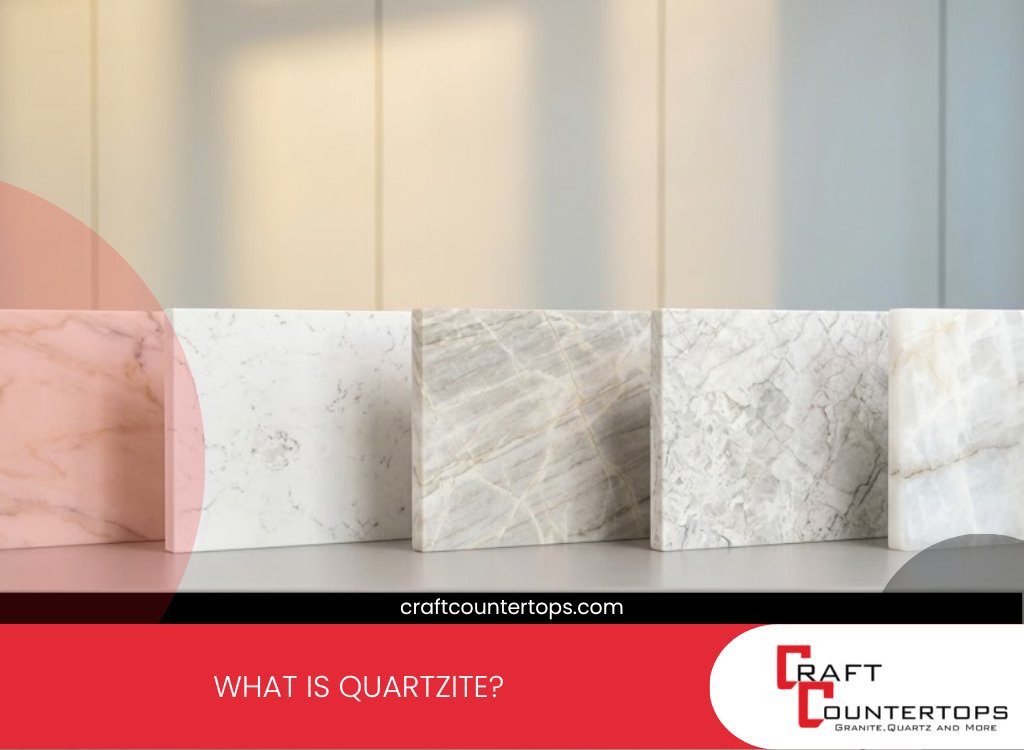
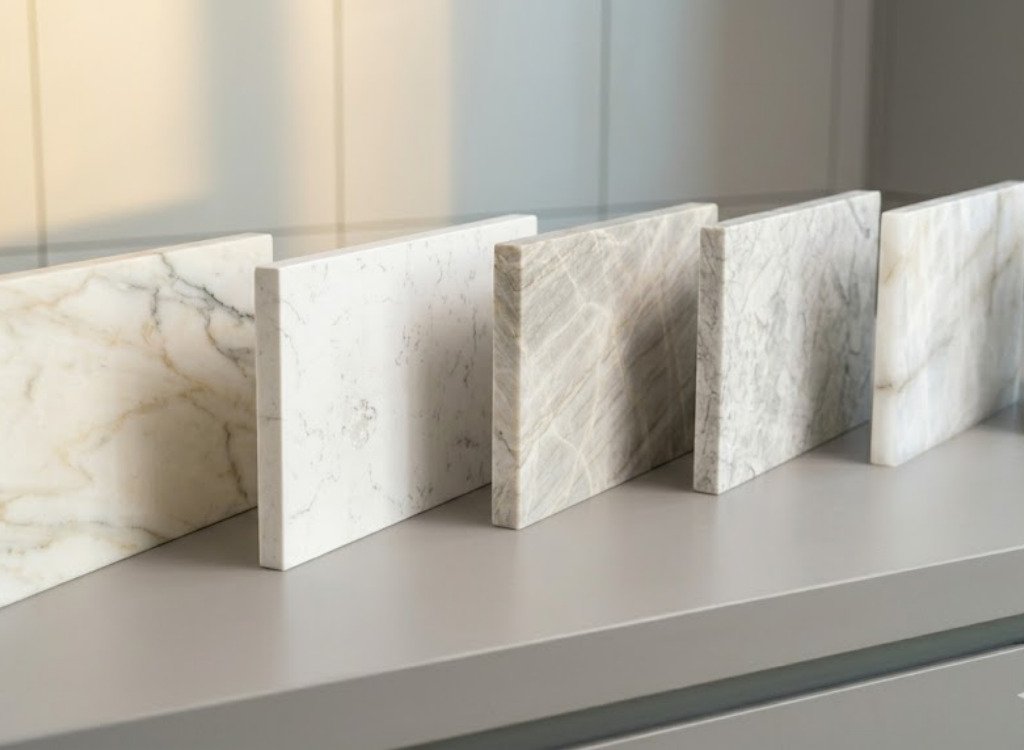
Quartzite comes in a wider range of colors and patterns than most people expect. The most well-known options have a white or light gray base with flowing veining — similar to marble. But quartzite also comes in blues, greens, golds, and dramatic multi-color patterns.
Here are several quartzite options available at Craft Countertops:
Taj Mahal — One of the most popular quartzite options in Northern Virginia. Warm white background with soft gold and cream veining. Looks similar to high-end marble but performs significantly better in a kitchen.
Sea Pearl — A soft white and gray quartzite with subtle movement. Works beautifully with both white and dark cabinets.
Calacatta Macaubas — White base with dramatic gray veining. One of the most marble-like quartzite options available.
Super White — Bright white with minimal veining. Clean, modern look with natural stone durability.
Denali — Soft gray and white with gentle movement. A calm, versatile option for transitional kitchens.
Fantasy Brown — Warm beige and brown tones with flowing gray veining. Pairs exceptionally well with wood-toned and cream cabinets.
Cristallo — A translucent, luminous quartzite with white and gold tones. One of the most striking natural stone options available.
Azul Imperiale — Deep blue and gray tones with dramatic movement. For homeowners who want a bold, one-of-a-kind statement piece.
See the full quartzite collection at Craft Countertops.
Is Quartzite Good for Kitchen Countertops?
Yes — quartzite is an excellent kitchen countertop material for the right homeowner. Here is an honest look at how it performs day to day.
Scratch resistance: Quartzite is very hard and resists everyday scratches well. Cutting directly on the surface is still not recommended — more to protect your knife than the countertop — but it holds up to normal kitchen use reliably.
Heat resistance: Quartzite handles heat very well. Unlike quartz, there is no resin in the material, so a hot pan placed briefly on quartzite will not cause the discoloration or cracking you risk with engineered surfaces. Trivets are still a good habit, but the risk level is much lower.
Stain resistance: Quartzite is porous and needs sealing to resist stains. A properly sealed quartzite countertop handles everyday kitchen spills well. The key word is “sealed” — unsealed quartzite will absorb liquids and stain over time.
Etching: True quartzite does not etch from acidic foods the way marble does. This is one of the most important practical differences between quartzite and marble, especially for homeowners who love the marble look but cook frequently.
Durability: According to the Natural Stone Institute, quartzite is among the most durable natural stone materials available for residential use. Its hardness makes it resistant to chips and surface damage in ways that softer stones cannot match.
What Are the Downsides of Quartzite?
Being honest about the downsides helps you make the right decision.
It needs sealing. Unlike quartz, quartzite is not maintenance-free. It needs sealing every one to two years to stay stain resistant. This is less frequent than some granite options, but it is still a commitment. See the granite sealing guide for a sense of what that process looks like — quartzite sealing is very similar.
Quality varies. Not all stone sold as “quartzite” is true quartzite. Some softer stones — particularly certain white marbles and dolomitic marble — get mislabeled or misidentified as quartzite in the supply chain. A reputable fabricator who knows the material is important. Ask where the stone was sourced and whether it has been tested for hardness if you have any doubts.
It costs more than granite. Quartzite is generally priced higher than granite, reflecting both its rarity and the demand for premium options like Taj Mahal and Cristallo. For homeowners on a mid-range budget, granite offers similar heat resistance and natural stone character at a lower price point.
Limited fabricator expertise. Some fabricators do not work with quartzite regularly. The material requires specific knowledge to cut and fabricate correctly. Choosing a fabricator with experience handling quartzite specifically matters more than it does with more common materials.
Quartzite vs. Marble: What Is the Difference?
Many homeowners consider quartzite specifically because it looks like marble but promises better performance. That comparison is worth understanding clearly.
Marble is a metamorphic rock made from limestone. It is softer than quartzite — typically 3 to 4 on the Mohs hardness scale — and it etches when it contacts acidic foods and drinks. The famous veining in marble is beautiful, but the soft surface comes with real trade-offs in a cooking kitchen.
Quartzite is harder, does not etch from acids the way marble does, and handles heat better. The best quartzite options — Taj Mahal, Calacatta Macaubas, Super White — deliver a look that is very close to high-end marble with significantly better kitchen performance.
If you want the marble look without the marble maintenance anxiety, quartzite is the most direct answer to that problem.
Is Quartzite Worth the Price?
Quartzite costs more than most granite and more than most quartz. Whether it is worth the premium depends on what you are looking for.
If you want natural stone that looks like marble, handles real kitchen use without etching, and creates a one-of-a-kind surface that no engineered product can replicate — quartzite delivers on all three.
If you want zero maintenance, consistent patterning, and the lowest possible upkeep, quartz is the better fit.
If you want the best price-to-performance ratio in natural stone, granite is hard to beat.
All three options are available at both Craft Countertops locations. The right choice depends on your priorities, your kitchen use, and your budget — and those are exactly the conversations the team helps with during a free estimate.
FAQ: What Is Quartzite?
What is quartzite made of? Quartzite is a natural metamorphic rock formed when sandstone is exposed to intense heat and pressure deep underground over millions of years. That process fuses quartz grains together into an extremely hard, dense stone. It contains no synthetic materials or resin.
Is quartzite the same as quartz? No. Quartzite is a natural stone mined from the earth. Quartz (engineered quartz) is a manufactured product made from ground quartz crystals bound with polymer resin. They look similar in some patterns but have different maintenance requirements, heat tolerance, and performance characteristics.
Does quartzite need to be sealed? Yes. Quartzite is a natural porous stone that needs sealing to resist stains. A quality seal typically lasts one to two years with normal kitchen use. The sealing process is straightforward and most homeowners do it themselves.
Is quartzite harder than granite? True quartzite is generally harder than most granite, ranking 7 to 8 on the Mohs hardness scale. That hardness makes it highly scratch resistant and durable for kitchen use.
Does quartzite etch like marble? No — and this is one of the main reasons homeowners choose quartzite over marble. True quartzite does not etch from acidic foods and drinks the way marble does. It is a much more practical choice for a kitchen that sees daily cooking.
What is the most popular quartzite countertop color? Taj Mahal is consistently one of the most requested quartzite options, particularly in Northern Virginia and West Virginia. Its warm white base with soft gold veining delivers a high-end marble look with significantly better kitchen performance.
How is quartzite different from marble? Both are natural metamorphic stones, but quartzite forms from sandstone while marble forms from limestone. Quartzite is harder, more scratch resistant, and does not etch from acids the way marble does. Marble is softer and requires more careful maintenance in a cooking kitchen.
Is quartzite more expensive than granite? Generally yes. Quartzite is priced higher than most granite options, reflecting its rarity and the premium nature of popular patterns. For homeowners who want natural stone on a tighter budget, granite offers excellent performance at a lower price point.
Where can I see quartzite slabs in person near me? Craft Countertops carries a selection of quartzite slabs at the Sterling, VA and Martinsburg, WV showrooms. Seeing the actual slab in person is the only reliable way to evaluate a natural stone before committing.
See Quartzite in Person at Craft Countertops
Quartzite photographs well but looks even better in person. The translucency and depth of slabs like Cristallo and Taj Mahal are difficult to capture in a photo.
The team at Craft Countertops can walk you through current quartzite inventory, explain the differences between specific slabs, and help you understand exactly what maintenance to expect before installation day.
Visit the showroom in Sterling, VA or Martinsburg, WV, or get a free estimate online to get started.
Serving homeowners across Virginia, West Virginia, Maryland, and Washington, DC since 1992.
Related reading: Quartzite Countertops: Natural Stone With Lowest Complaints | Heat Resistant Countertops: 5 Best Options Ranked | Low Maintenance Countertops: 5 Best Options Ranked | Quartz vs. Granite Countertops Guide